Filter by topic and date
IETF 104 Highlights
- Alissa Cooper IETF Chair
8 Apr 2019
Prague proved once again to be a productive and fun venue to advance the work of the IETF.
The IETF community gathers in person because human connections are important in making the Internet work better. Sometimes an issue that has been discussed on a mailing list or a proposal for a new idea cannot be fully understood without an opportunity for those interested to gather together in physical space for discussion. IETF 104 showcased the many different ways in which having a physical meeting can substantially advance the work of our community over the course of just one week’s time.
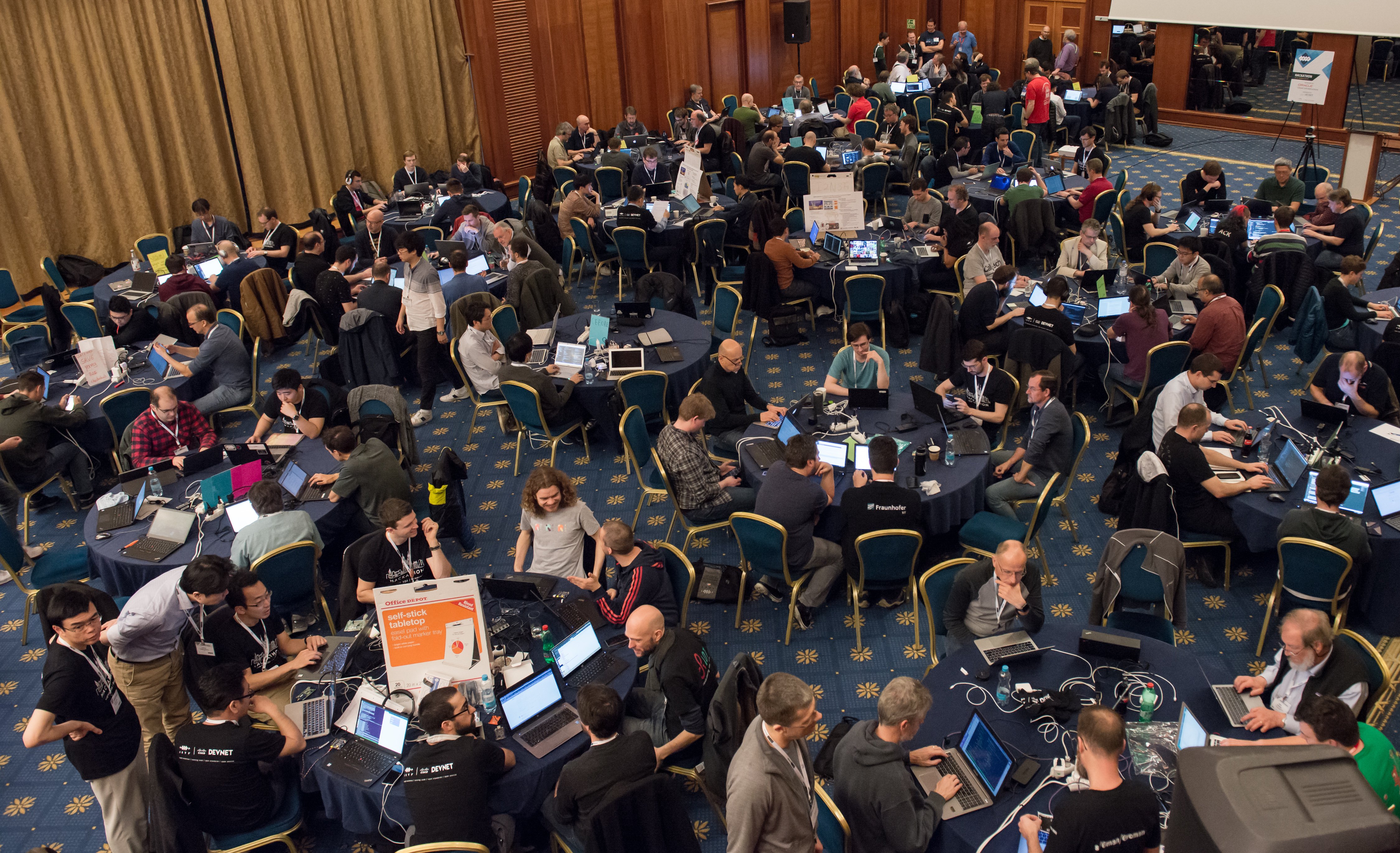
We kicked off the week with our largest IETF Hackathon yet: 370 on-site participants collaborated on 44 projects over the course of two days. It was especially nice to see attendees from the co-located Netdev conference join for the weekend of collaborative coding. With the possibility of increased participation to continue, we’ll do our best to have coffee more available the next time around!
The working group meetings, Birds of a Feather sessions (BOFs), and side meetings made substantial progress on a number of new topic areas. Further discussions based on the new, shared understandings are expected in the coming months. Among the key exchanges were:
Discussions about deployment considerations for DNS confidentiality in the DNS Over HTTPS (DOH) and DNS PRIVate Exchange (DPRIVE) working groups as well as a side meeting allowed participants to air their concerns and explore in more detail the specific deployment plans of individual providers. Discussion will continue on the Applications Doing DNS (ADD) mailing list and will hopefully retain the spirit of cooperation glimpsed at the side meeting. (see photos below)
The Collaborative Automated Course of Action Operations for Cyber Security (CACAO) BOF explored the concept of exchanging standardized, machine-readable “playbooks” used by security and network operations centers to respond to attacks. The BOF discussion helped to narrow the problem space and elucidate how the work might be phased if it proceeds in the IETF. Discussion about next steps and a potential second BOF will continue on the mailing list.
Work on JSON canonicalization, aiming to make data exchanged in the JSON format more usable for secure cryptographic operations, was discussed in Security Dispatch (SECDISPATCH) and DISPATCH working groups, and a side meeting. The discussions piqued the interest of those who previously worked on the JOSE standards, and future collaboration seems possible. Further discussion and preparation of a BOF proposal will continue on the mailing list.
Similarly, after a productive side meeting and conversation in DISPATCH, work on Web Packaging—which would provide the ability for signed bundles of information to be served by web servers other than the origin that owns them—is likely to be proposed for a BOF at IETF 105. Follow the mailing list for updates.
As the march towards completing the first version of the QUIC protocol chugs along, the Transport Area Open Meeting (TSVAREA) session hosted several talks about QUIC logging for debugging and troubleshooting. More implementation experience is required to determine if standardization is needed here, but expect to see this discussion continue over the next several meeting cycles.
Several sessions also touched on how we collaborate with other standards organizations on shared work. The conclusion of the BNG Control-plane And User-plane SEparation (BCAUSE) BOF, which focused on standards to support the separation of the subscriber management control plane from the traffic forwarding user plane in broadband network gateways, was that progress on specific IETF work items will await the development of requirements in the Broadband Forum (BBF). In the Transport Area Working Group (TSVWG) and Internet Area Working Group (INTAREA) there were discussions about using Multipath TCP (MPTCP) or other multi-path transport protocols to support potential requirements stemming from 3GPP work on 5G access traffic steering, switching, and splitting. And in light of a liaison statement received from the IEEE 802.1 working group, the Link State Vector Routing (LSVR) working group decided to put on hold its work on a layer 2 discovery protocol while IEEE 802.1 further develops the next generation of its Link Layer Discovery Protocol (LLDP). We are fortunate to have attendees who engage deeply in multiple different standards organizations and can facilitate these kinds of decisions.

Finally, our experiment in providing unstructured time in the agenda on Wednesday afternoon yielded a dense schedule of side meetings together with a well received Technical Deep Dive on modern router architecture and plenty of hallway conversations. Anyone who has feedback on the agenda or any other aspect of the meeting is highly encouraged to fill out the meeting survey. It takes about five minutes to complete. The Internet Engineering Steering Group. (IESG) will use the survey results and other feedback received to determine the next steps for agenda experimentation.
See you on the mailing lists!