Filter by topic and date
IESG Strategic Retreat
- Alissa Cooper IETF Chair
28 Oct 2019
The IESG held a second retreat in 2019 to focus on strategic objectives.
For many years, the Internet Engineering Steering Group (IESG) has had one annual retreat where we meet face-to-face for a couple of days of discussion and team building. This year, the group decided to hold a second retreat focused on a more strategic level of thinking. The second retreat took place October 9-10 in Amsterdam. We invited Internet Architecture Board (IAB) members to join us as well. Zhenbin Li, Wes Hardaker, and Jari Arkko attended in addition to ex officio IESG member and IAB Chair Ted Hardie.
Prior to arriving at the retreat, we collectively gathered our thoughts about the IETF's strengths, weaknesses, opportunities, and threats, as well as the political, economic, social-cultural, and technological forces likely to affect the IETF in the coming years. Four high-level areas of interest emerged out of this collection which we used to structure our discussions at the retreat: technology, externally facing IETF operations (like total cost of meeting attendance), IETF culture, and IETF process.
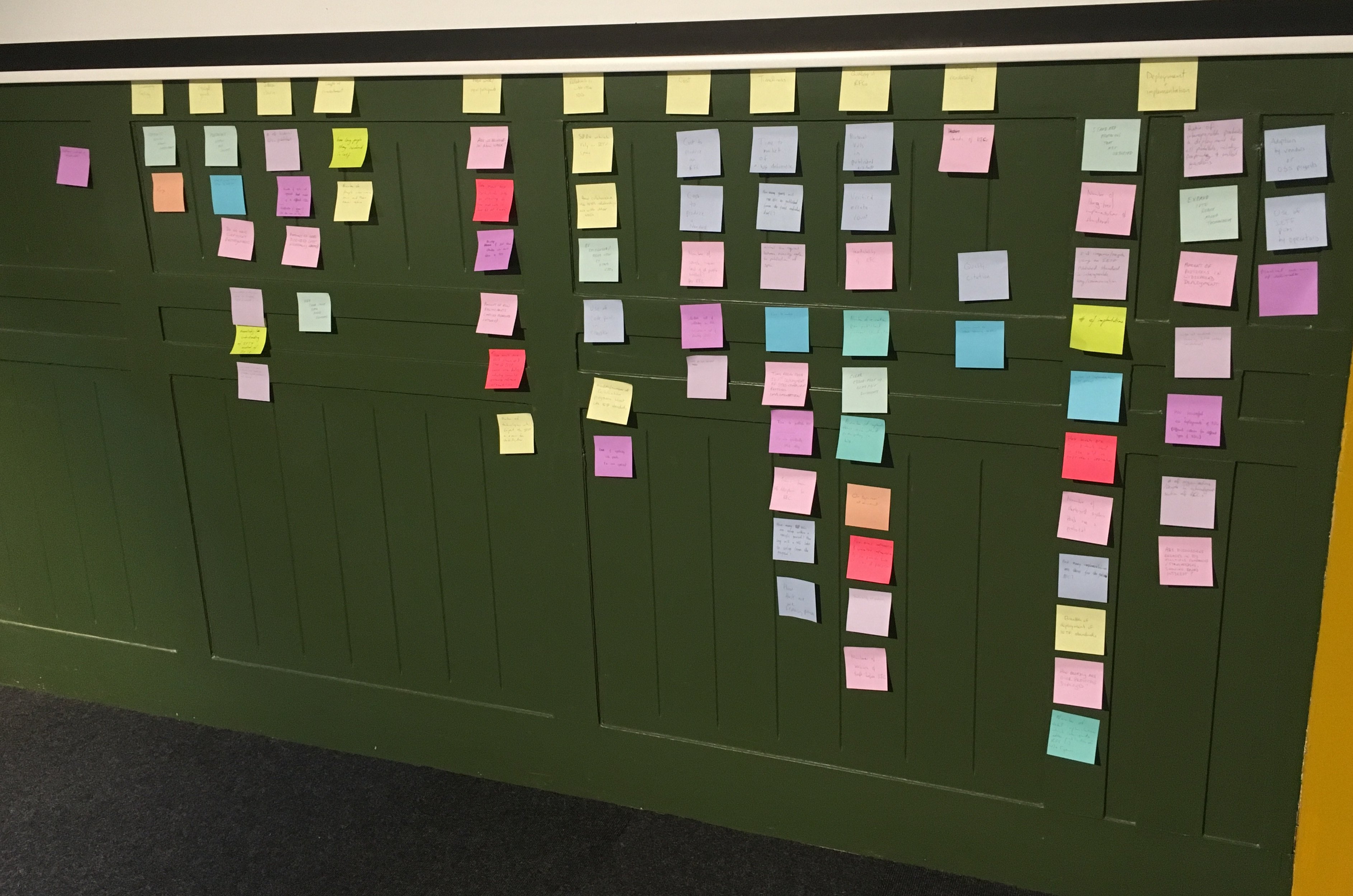
We began the retreat by brainstorming about how best to assess the IETF's effectiveness. From a large pool of ideas generated about metrics of effectiveness, there was one that we all agreed was our top metric: deployment of IETF standards. Others that seemed highly significant to us were the timeliness, cost, and quality of IETF standards. We did not precisely define these or sketch out schemes to make them measurable, although we may revisit that work in the future. Our main goal was to have a shared understanding of how to assess the IETF's effectiveness to help shape the rest of our discussions at the retreat.
We spent the bulk of our time focused on the four themes listed above, thinking about improvements we could make in each area to make the IETF more effective, what data we need to understand problem areas, the roles of various actors inside and outside the IETF community, and how we might measure success. We split into two breakout groups and generated 30 ideas for improvements that could be made across the four themes. Out of that list we identified four sizable initiatives of most interest to the IESG at this time based on their expected impact and effort involved. We also noted a number of other items for potential future work. The four sizable initiatives were:
- Creating more transparency in the IETF Datatracker about how long an Internet-Draft has been in each stage of processing and who has the token to move it from initial submission to publication;
- Supporting groups that are not quite like working groups or research groups, but potentially offer a means for collaboration among those interested in specific technologies that do not yet have a home in the IETF or Internet Research Task Force (IRTF);
- Being more organized and getting more professional support to help us explain the IETF and its work to external audiences; and
- Exploring how to support mechanisms for receiving anonymous or private feedback (for example, about the leadership or other participants) as a more common practice.
At this point, all of these are initial ideas that need much further discussion before they can be developed and operationalized. We are tracking them on our action items list and will be seeking input and participation from the community once we have them better scoped out.